SAT I/(II).AD*.ms-vps(1-4).a, variety of characteristics / (slightly) gritty
reddish/orange to brownish firing
in some cases with a grayish to black core on the interior side of the cross section
occasionally irregularly stained
predominance of rounded to sub-rounded Quartz/Feldspar inclusions
late 9th – 6th century BC
1712 diagnostic shards attributed to this fabric*
contribution by research master student Jord Hilbrants (2012)
* the current presentation includes exclusively stands / cooking stands within this fabric. Other types belonging to the fabric are: table wares / cooking vessels (olla’s, jars, plates), storage vessels (dolia), spinning equipment (loom weights, spindle-whorls, spools) and architectural building materials (tiles). All ceramics not belonging to stands / cooking stands still have to be investigated in more detail before they can be added to the current web presentation
FRESH CROSS SECTION and FABRIC DESCRIPTION
THIN SECTIONS
ASSOCIATED CERAMICS
FRESH CROSS SECTION
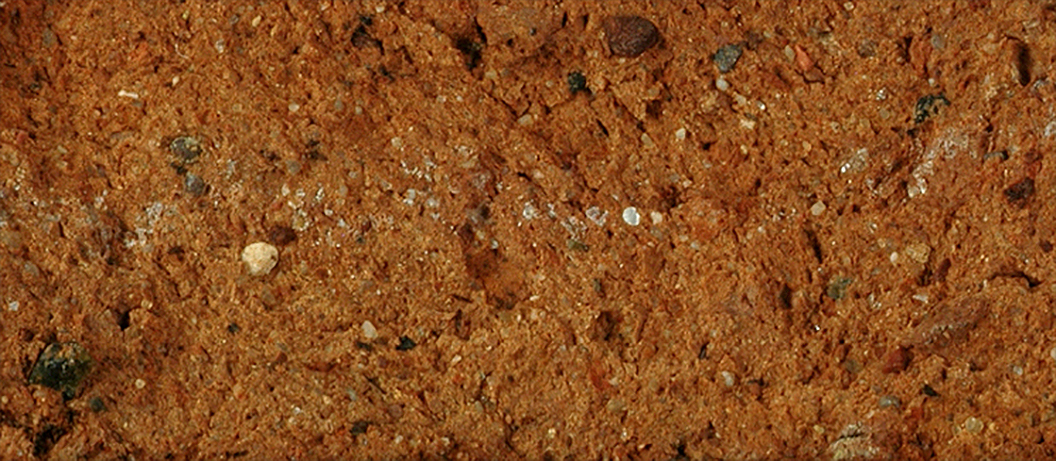
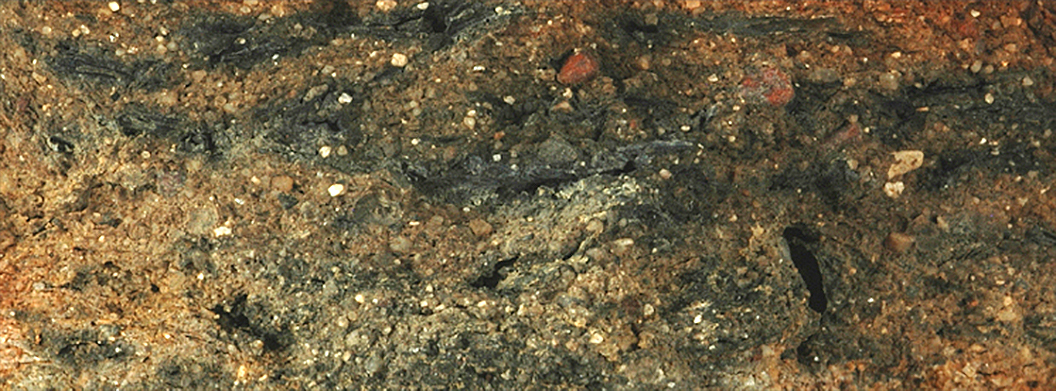
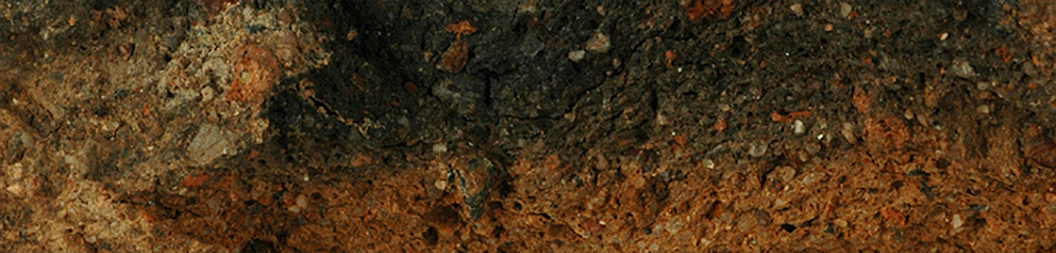
FABRIC DESCRIPTION
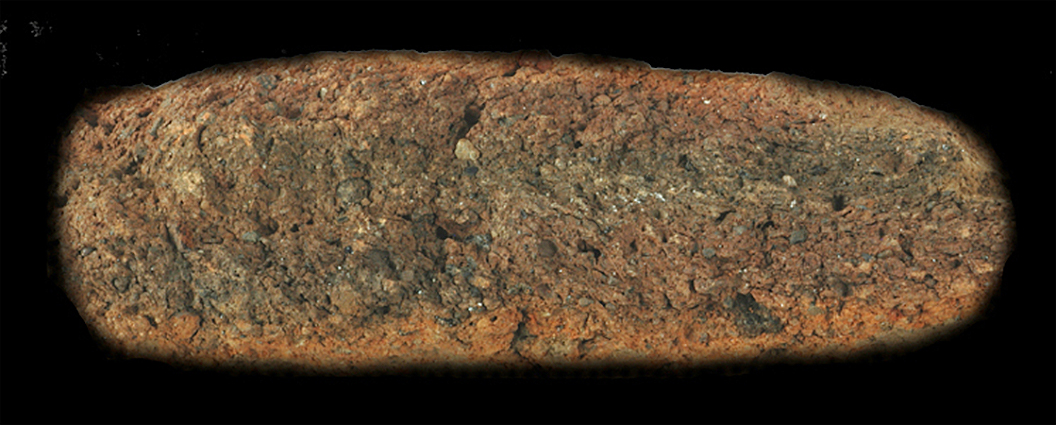
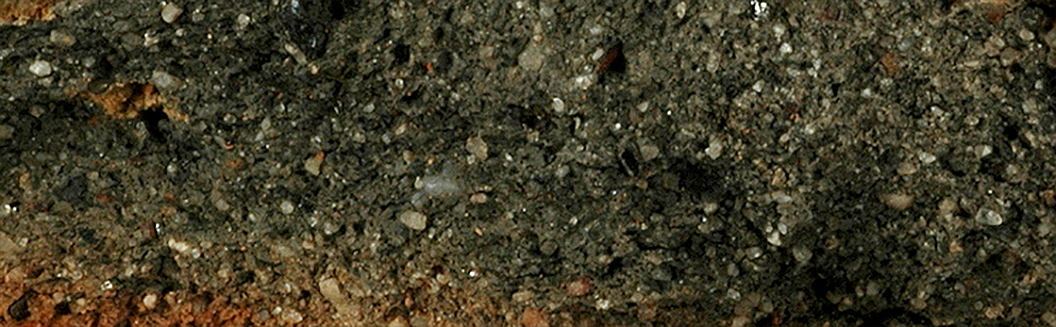
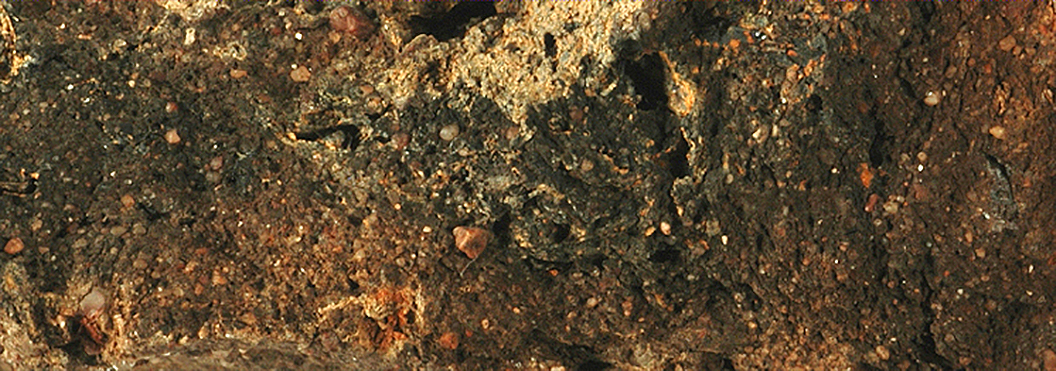
The description is made on the basis of microscopical observation up to x30 (see images of fresh cross sections above and table below).
The shards within this fabric are fired to a reddish/orange to brownish colour, sometimes with a greyish to black core. Predominant Munsell colours are: 2.5 YR 4/6 (red), 5 YR 4/4 (reddish brown), 5 YR 4/6 (reddish brown), 7.5 YR 4/4 (greyish red) and 10 YR 2/1 (deep reddish brown), although there seems to be a high variety of colours. After refiring of selected fragments the colour range narrowed to predominantly 2.5 YR 3/4, 2.5 YR 4/6 and 2.5 YR 4/8, confirming the strong relationship within the fabric on the level of source material.
The composition of inclusions is characterized by predominance of fine, mainly rounded to sub-rounded Quartz/Feldspar. The colourless/transparent inclusions are hard to detect by eye, which is complicated by the rich variety in colours of the fired clay. This may lead to the impression that the material within the current fabric does not posess comparable characteristics. The overall description of inclusions can be summarized as: some sherds contain merely Quartz-Feldspar up to about 35%, other sherds contain a variety of inclusions (e.g. flint, augite, ferro-mangane and grog) with clear predominance of Quartz-Feldspar.
This fabric is related to:
SAT I.AD.ns(1-4).a, ((extremely)large) FeMn nodules / crumbling / gritty
SAT I.AD*E.ms-ps(1-4).a, fine gritty
SAT I/(II).AD*.ms-ps(1-4).b, variety of characteristics
SAT II.ADe.ms-vps(1-4).ab, variety of characteristics
Properties of SAT I/(II).AD*.ms-vps(1-4).a, variety of characteristics / (slightly) gritty in a fresh cross section (x: absent / p: present < 1%)
| fabric | SAT I/(II).AD*.ms-vps(1-4).a, variety of characteristics / (slightly) gritty | |||||
| volume of inclusions | >20% (regularly up to 30/35%) |
|||||
| sorting | moderately - very poorly sorted |
|||||
| particle size | <710 (regularly larger and up to 1400, sporadically to a few mm.) |
|||||
| quartz/feldspar | 25% (regularly up to 30/35%) | |||||
| flint | x-3% (occ. up to 5%) | |||||
| augite | x-10% | |||||
| olivine | x-1% | |||||
| FeMn | x-3% (occ. up to 7% / occ. stains) | |||||
| mica | x-p | |||||
| leucite | x-p | |||||
| leucite-tuff/lava | x-p | |||||
| tuff | x-p (sporadically / sometimes up to 5 mm.) | |||||
| volcanic glass | x-p | |||||
| grog | x-1% (occasionally up to 5%) | |||||
| organic inclusions | x-p (in black voids or striations) | |||||
THIN SECTIONS
LF 5/15
Fragment of hair pertaining to a terracotta sculpture. Within the thin section the following aspects are visible: a high percentage of inclusions (20-25%), ms-ps with predominance of Quartz/Feldspar (15-20%). The inclusions are rounded to angular, occasionally euhedral. Substantially present is FeMn and /or Grog 5-7%. Some of these inclusions show a micaceous structure comparable to the clay structure. Others have the appearance of FeMn. Occasionally inclusions posses both characteristics. Some additional flint, Biotite and Augite are also present (p-1%).
S 1973/04
Rim fragment. The AD fraction in this thin section is ms-ws. Under the microscope this is underlined in the ms-ws sorting of a very predominant Quartz/Feldspar fraction of 20-30%. Additionally some FeMn-nodules are present (3-5%), just like flint (p-1%) and a few Augite particles (p). Some Plagioclase Feldspars can be detected. The thin section represents a border area of the fabric properties, linking it to the other fabrics within the fabric family (e.g. SAT I(II).AD*.ms-ps(1-4).b) and SAT II.ADe.ms-vps(1-4).ab, variety of characteristics).
S 2251/71
Rim fragment. Impression of a high to very high percentage of inclusions, mainly rounded, to a lesser degree angular, occasionally euhedral. Clay flakes and fissures are orientated randomly. There is a predominance of Quartz and Feldspars in 20-30%. Also present are Augite (3-7%), FeMn-nodules in a variety of sizes (3-5%), Biotite (p), Flint (p) and Volcanic glass (p). Plagioclase feldspars have been detected only sporadically.
S 3706/01a & S 5173/div
no description available
LF 5/15
thin-section in plain polarised light (ppl) / field of view: 0.31 x 0.46 cm.
LF 5/15
thin-section in plain polarised light (cp) / field of view: 0.31 x 0.46 cm.
S 1973 / 04
thin-section in plain polarised light (ppl) / field of view: 0.39 x 0.59 cm.
S 1973 / 04
thin-section in plain polarised light (cp) / field of view: 0.39 x 0.59 cm.
S 2251 / 71
thin-section in plain polarised light (ppl) / field of view: 0.66 x 1.0 cm.
S 2251 / 71
thin-section in plain polarised light (cp) / field of view: 0.66 x 1.0 cm.
S 3706 / 01a & S 5173 /div
thin-section in plain polarised light (ppl) / field of view: 0.58 x 0.86 cm.
S 3706 / 01a & S 5173 /div
thin-section in plain polarised light (cp) / field of view: 0.58 x 0.86 cm
ASSOCIATED CERAMICS
drawings are not represented on an identical scale
for exact dimensions of individual fragments: see description
COOKING STAND
STAND
COOKING STAND
COOKING STAND (plate)
COOKING STAND (wallfragment)
COOKING STAND (base)
TYPE A
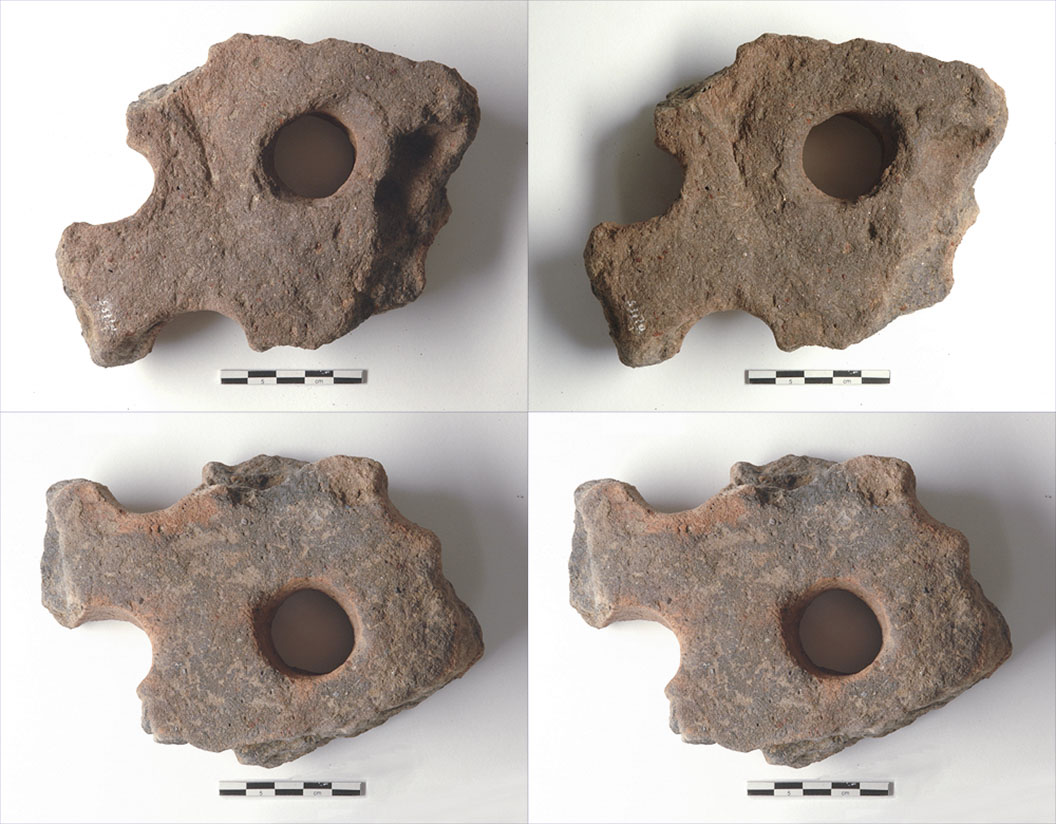
Cooking stand plate type A is characterized by: large ventilation openings placed at regular intervals; to some extent a finished top, irregular/unfinished reverse side; thickness of around 3 – 3.5 cm.
S 3770/1
Fragment of top-plate with one completely preserved and three partially preserved ventilation openings; plate flattened on top, irregular reverse side.
finished side: 2.5 YR 3/1 (very dark grey)
reverse side: 10 YR 6/4 (light yellowish brown) & 5 YR 5/8 (yellowish red)
14.8 x 10.6 x 3.5; diameter of perforations: 2.8-3.5 cm
secondary burned; handmade
8th-6th century BC
compare:
- Bouma (1996): cat.23, cat.24, cat.25 (pp.147+Plate II; 7-6th century BC), cat.147 (pp.154+Plate IX).
- Maaskant-Kleibrink (1992): cat.1389 (pp.162+269; 650-600/590 BC [IIB]), cat.1499 (pp.169+275; 590-580/70 BC [IIC]), cat.1662 (pp.179+287; 830-725 BC [IA]), cat.1753 (pp.185+293; 830-725 BC [IB]), cat.1849 (pp.191+300; 590-580/70 BC [IIC]), cat.2283 (pp.218+334; 650-600/590 BC [IIB]).
- Ginge (1996): HUS27 (pp.147+150; phase 1-4: 850-500 BC), HUS28 (pp.147+150), HUS29 (pp.147+150), UST5 (pp.147+156; phase 1-6: 850-100 BC).